If you have been sourcing heat patches for any length of time, you have probably encountered both private label and white label offerings, and the terms are often used interchangeably by trading companies, Amazon resellers, and even some manufacturers. After 36 years of supplying B2B partners worldwide, KONGDY has seen this confusion cost buyers real money in the form of wrong inventory purchases, brand mispositioning, regulatory headaches, and lost shelf space at retail.
The reality is that private label and white label represent two fundamentally different go-to-market strategies with different cost structures, different control levels, and different brand outcomes. Understanding the 12 key differences between them is essential before signing any manufacturing agreement, especially when you are investing $50,000 to $500,000 in inventory and marketing.
This guide breaks down the technical, commercial, legal, and strategic distinctions across 12 dimensions, explains which model fits which B2B scenario, and shares the decision framework our 800+ partners use when choosing between private label and white label partnerships.
Before diving into the differences, we need rock-solid definitions. Both models involve a third-party manufacturer producing heat patches for the buyer, but the ownership, branding, and customization layers differ dramatically.
Private label means the buyer owns the brand and either commissions a manufacturer to produce an exclusive formula/packaging or selects an existing formula from the manufacturer catalog and re-brands it under the buyer's brand. The buyer controls the brand narrative, pricing, distribution channels, and customer relationships. The manufacturer's name typically does not appear on the product, and the formula may be exclusive or shared across a limited partner pool depending on the agreement.
White label means the manufacturer produces a generic, fully developed heat patch product that any buyer can purchase, re-brand, and resell. Multiple buyers may sell the same underlying product under different brand names. The manufacturer may even offer the product on its own website or through multiple distribution channels simultaneously. White label is sometimes called "generic manufacturing" or "OEM catalog products" depending on the region.
Many Chinese manufacturers and trading companies use "private label" and "white label" interchangeably because the underlying manufacturing process is similar. However, the commercial exclusivity, brand control, and regulatory responsibility differ substantially. KONGDY's contract templates distinguish the two explicitly, and buyers should always confirm which model they are purchasing before signing.
In a private label arrangement, the buyer registers the trademark in target markets and bears all brand-building costs including logo design, packaging graphics, regulatory artwork, and marketing. In a white label arrangement, the buyer often uses a quick brand wrapper (a logo + color scheme) over an existing product, with minimal trademark investment beyond basic registration. KONGDY recommends buyers investing in long-term brand equity always choose private label.
True private label heat patches can include formula exclusivity where the buyer pays an exclusivity premium (typically $5,000 to $30,000) to prevent the same formula from being sold to direct competitors. White label products are never formula-exclusive — the same formulation is sold to multiple buyers and may even appear under different brand names on Amazon, in pharmacies, and in retail chains. Some KONGDY partners request territorial exclusivity (e.g., exclusive distribution in Germany) which is a hybrid model we support.
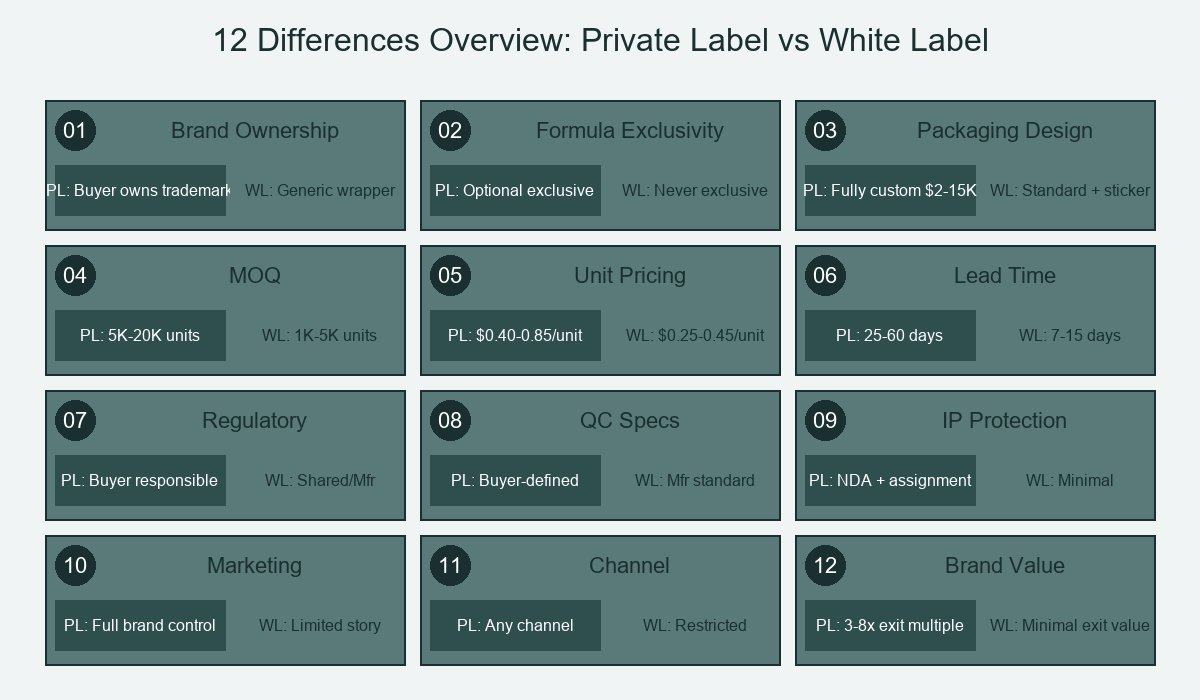
Private label packaging is fully customized: structural design, materials, artwork, regulatory text, language variants, batch coding, and retail-ready features like hang tags, blister cards, or window boxes. The buyer typically invests $2,000 to $15,000 in professional packaging design. White label uses existing manufacturer packaging with the buyer's logo sticker or simple label swap — design cost is often under $500 but the result looks generic on shelf.
White label heat patches have lower MOQs because the manufacturer uses existing tooling, existing raw materials, and existing production schedules. Typical white label MOQ at KONGDY is 1,000 to 5,000 units per SKU. Private label MOQs are higher due to dedicated production runs: 5,000 to 20,000 units per SKU for established formulas, or 10,000+ for fully custom formulas requiring new tooling or new ingredient sourcing.
Per-unit pricing differs by 30% to 80% between the two models. White label patches at KONGDY range from $0.25 to $0.45 per unit at typical MOQs. Private label patches range from $0.40 to $0.85 per unit depending on customization. However, private label offers higher retail margins (typically 60% to 80% gross margin) while white label competes in a commoditized segment with 30% to 50% margins.
White label production lead time is 7 to 15 days because the manufacturer has stock or near-stock formulas. Private label lead time is 25 to 60 days because production is scheduled after the buyer confirms artwork, regulatory text, and any custom tooling. KONGDY's standard lead times are 10 days (white label) and 35 days (private label) for typical orders.
In private label arrangements, the buyer is typically the responsible party for product registration, safety assessments, and post-market surveillance in target markets. The manufacturer provides technical documentation, but the brand owner signs the regulatory declarations. In white label, regulatory responsibility is sometimes shared or even primarily rests with the manufacturer depending on the market. KONGDY provides comprehensive regulatory dossiers for both models but recommends buyers engage local regulatory consultants for private label expansion.
Private label allows the buyer to specify detailed quality standards: ingredient grades, adhesive strength, heat duration curves, dimensional tolerances, and packaging durability. The manufacturer must meet these specs or face rejection/penalty. White label products come with the manufacturer's standard QC and the buyer has limited input. KONGDY's private label QC includes buyer-defined inspection protocols, third-party pre-shipment inspections, and batch retention samples.
Private label formulas, packaging designs, and brand elements are protected by NDAs, non-compete clauses, and IP assignment agreements. White label has minimal IP protection beyond trademark — competitors can access identical or similar products with a quick search. For buyers building defensible brand value, private label IP protection is non-negotiable.
Private label buyers control the entire brand narrative: product positioning, ingredient stories, target demographic, pricing psychology, and content marketing. White label buyers are limited to marketing the brand wrapper without access to proprietary product stories. Long-term brand equity (Coca-Cola, Dyson, Apple model) requires private label.
White label heat patches may have restricted distribution channels if the manufacturer sells through competing channels (e.g., Amazon, retail chains, pharmacy chains). Private label buyers can sell through any channel including direct-to-consumer, retail, wholesale, B2B, and international markets without manufacturer interference. KONGDY enforces channel restrictions for white label partners to prevent channel conflict.
Private label brands can be sold, licensed, or valued as intangible assets — KONGDY partners have exited private label heat patch brands for 3x to 8x annual revenue multiples. White label businesses have minimal exit value because the brand depends entirely on continuous supply from the manufacturer and the underlying product is non-exclusive. Investors and acquirers strongly prefer private label brand assets.
Choose private label heat patches when you are:
Typical private label buyer profile: established brands expanding into pain relief category, Amazon FBA sellers building $5M+ brands, DTC wellness brands, retail distributors with private label programs, and pharmaceutical companies expanding OTC portfolios. KONGDY private label clients typically order $100,000 to $5M annually after the initial launch.
Choose white label heat patches when you are:
Typical white label buyer profile: Amazon arbitrage sellers, promotional products distributors, corporate gift suppliers, discount retail chains, market testing operations, and short-term seasonal sellers. KONGDY's white label minimum order is 1,000 units with 10-day lead time, making it accessible for testing new markets quickly.
Many sophisticated B2B buyers combine both models within a single product portfolio. Common hybrid approaches include:
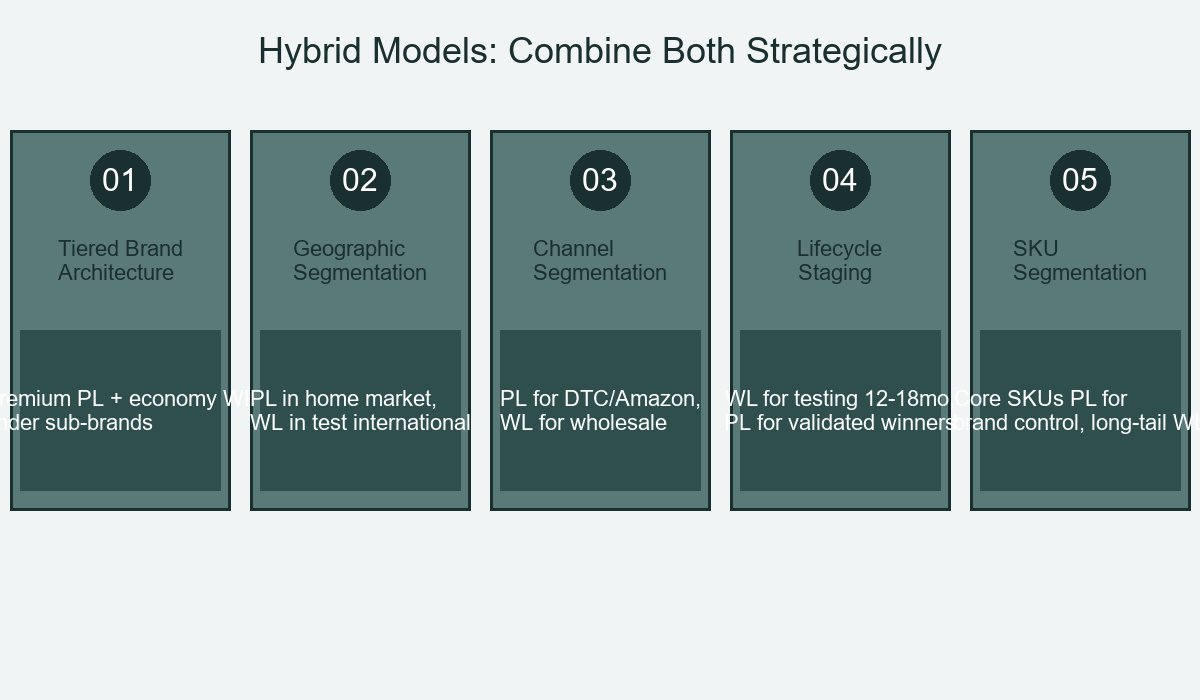
KONGDY supports hybrid portfolios with separate production scheduling, separate inventory tracking, and separate pricing tiers. Our partners have successfully scaled from white label-only to private label-dominant portfolios in 18-36 months as their brands mature.
Use this 5-question framework to determine the right model for your situation:
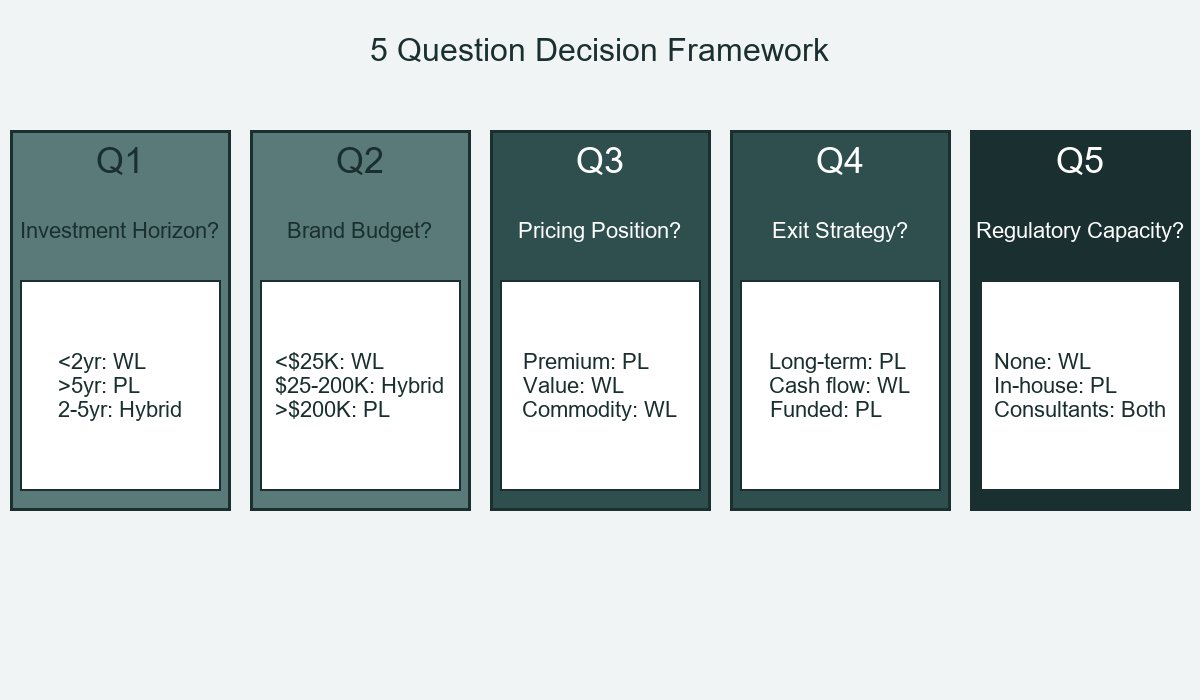
Under 2 years → white label likely better. Over 5 years → private label is the standard answer. 2-5 years → hybrid model recommended.
Under $25,000 → white label. $25,000 to $200,000 → hybrid possible. Over $200,000 → private label justified.
Premium positioning ($15+ retail) → private label required. Commodity positioning ($5 to $10 retail) → white label competitive. Value positioning ($3 to $5 retail) → white label dominant.
Long-term hold or sale → private label. Cash flow business → white label. Investor-funded scale → private label.
No regulatory team → white label simpler. In-house regulatory expertise → private label manageable. External regulatory consultants → both models workable.
The total cost of ownership differs substantially between models over a 3-year horizon.
Initial brand investment: $10,000 to $50,000. Packaging design: $2,000 to $15,000. Regulatory setup: $5,000 to $25,000. First production run (10K units): $5,000 to $10,000. Marketing launch: $20,000 to $100,000. Total Year 1: $42,000 to $200,000. Years 2-3 production at scale: $50,000 to $500,000 annually. KONGDY private label partners typically break even by month 18-24 and achieve positive ROI by year 3.
Initial brand wrapper: $500 to $2,000. First production run (1K-5K units): $500 to $2,500. Marketing: $5,000 to $20,000. Total Year 1: $6,000 to $24,500. Years 2-3 production: $10,000 to $100,000 annually. KONGDY white label partners typically break even by month 6-9 but face margin pressure as competitors access identical products.
Private label effective TCO per unit (amortized over 3 years, 50K units): $0.84 to $4.00. White label effective TCO per unit (amortized over 3 years, 50K units): $0.32 to $0.89. Private label retail margin: 60% to 80%. White label retail margin: 30% to 50%. Despite higher TCO, private label generates 2-3x higher absolute profit per unit.
KONGDY supports both private label and white label buyers with differentiated capabilities:
Full custom formulation (R&D team of 12 scientists). Structural packaging design (in-house design team). Regulatory documentation for FDA, CE, ISO 13485, Health Canada, TGA, PMDA. Formula exclusivity options. Dedicated production scheduling. Buyer-defined QC protocols. Private label MOQ from 5,000 units. Lead time 25-45 days.
20+ existing heat patch formulas ready for branding. Standard packaging templates (10+ designs). Quick-ship inventory on popular SKUs. Low MOQ from 1,000 units. 7-15 day lead time. Basic regulatory documentation. KONGDY-branded or unbranded options.
KONGDY partners frequently start with white label for market testing and transition top performers to private label after 12-18 months. We support transitions with formula locking, packaging redesign assistance, and production continuity. The transition typically takes 60-90 days and allows the partner to preserve market learnings while building brand equity.
Yes, but it requires contract amendment, new production runs, and regulatory re-registration in target markets. KONGDY supports transitions with 60-90 day project plans and continuity guarantees.
Per unit yes (30-80% higher), but per dollar of retail profit no — private label generates 2-3x higher absolute profit due to brand-driven pricing power.
KONGDY enforces channel restrictions to prevent white label partners from competing with their own products. Territory exclusivity is available for an additional premium in private label arrangements.
Private label buyers with proper IP assignment contracts retain all brand assets, formulas, and packaging designs. KONGDY's standard contract includes full IP assignment and formula documentation transfer rights.
Yes, formula exclusivity typically requires 50,000+ units annual commitment and an exclusivity premium of $5,000 to $30,000 depending on formula complexity.
The private label vs white label decision is fundamentally a question of brand ambition, not just budget. White label offers fast, low-cost market entry for testing and short-term arbitrage. Private label requires more investment but generates defensible brand equity, higher margins, and long-term exit value.
After 36 years serving 800+ B2B partners, KONGDY recommends most serious brand builders start with a hybrid approach: white label for market testing, private label for validated winners. This approach minimizes risk while building toward long-term brand equity. Whatever you choose, ensure your manufacturing contract clearly distinguishes the model, assigns IP appropriately, and protects your brand investment.
For buyers ready to discuss private label or white label partnerships with KONGDY, contact our B2B team at kongdyhealth.com with your target markets, annual volume projections, and brand positioning — we typically respond within 24 hours with a tailored proposal covering both options.